As the world looks set to overshoot the Paris Agreement limit of 1.5°C of warming, some carbon dioxide removal is now included in all IPCC scenarios for a livable climate. The chances of avoiding truly catastrophic levels of warming increasingly rely on ‘drawdown’, or being able to not only reduce current greenhouse gas emissions but also remove ‘historical’ emissions from the atmosphere. And startups around the world, big and small, are banking on and selling ideas ranging from pumping CO2 underground to using genetically engineered plants to capture more of it faster.
Scientists are trying to use CDR to balance an increasingly wobbly equation: if we want a safe climate, but we also keep putting more and more CO2 into the atmosphere, how much do we need to remove to not completely go off the rails? In the meantime, politicians are tempted to use carbon removal essentially as a ‘get-out-of-climate-jail-free’ card, betting on future generations to deal with current emissions and reach net zero.
Obviously, the real world has its limits, ranging from the total amount of land available for planting trees to political, economic and societal constraints. So, to push back against this runaway climate math, we hear more and more researchers talk about “feasible” CDR.
But what exactly is feasible when it comes to carbon removal? And how can journalists cover this growing industry in the interests of their audiences, current and future?
We will hear from:
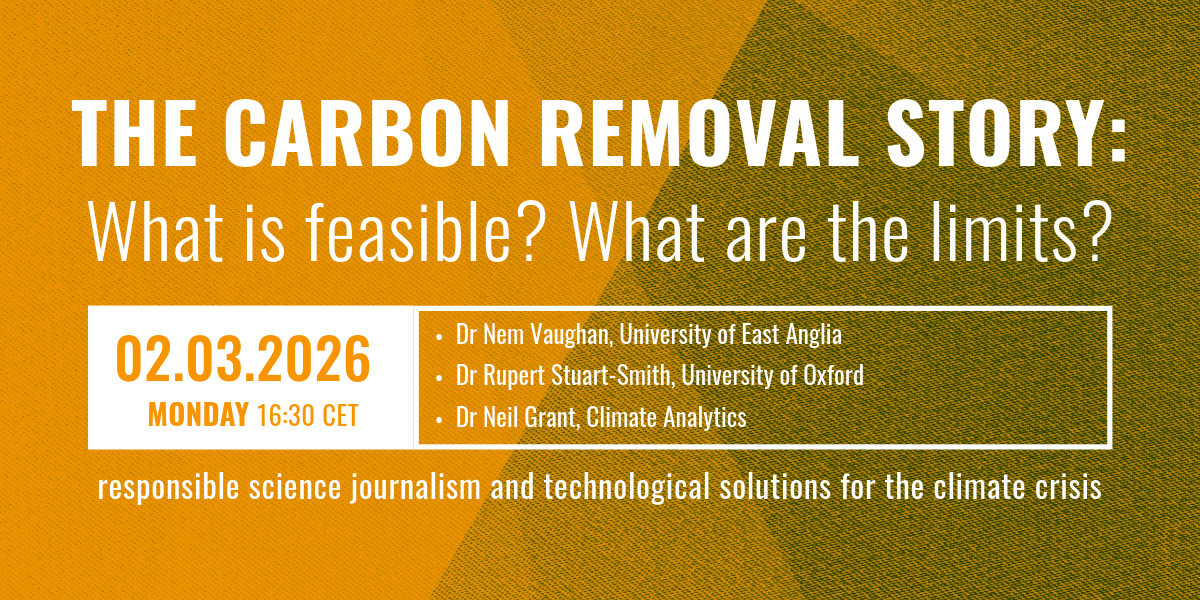
- Dr Nem Vaughan, Professor of Climate Change, Tyndall Centre for Climate Change Research, School of Environmental Sciences, University of East Anglia – on the sustainability limits to carbon removal,
- Dr Rupert Stuart-Smith, Deputy Director & Senior Researcher in Climate Science and the Law, Oxford Sustainable Law Programme – on the legal and political limits to how much CDR can be used in national climate plans,
- Dr Neil Grant, Senior Expert, Climate Analytics – on how much CDR is included in the ‘highest possible ambition’ scenario needed to return global temperatures to well below 1.5°C of warming.
This event is part of a series of online webinars and discussions exploring responsible science journalism on proposed technological solutions for the climate crisis, curated by Olga Dobrovidova, the former vice-president of EFSJ.
Register for the free event on Monday, March 2, at 16:30 CET here.